High-throughput screening
- Hundreds of clones characterized for expression, affinity, specificity.
- Down-selection designed to preserve backup options.
From AI-informed antigen design to pair selection and assay-ready performance.
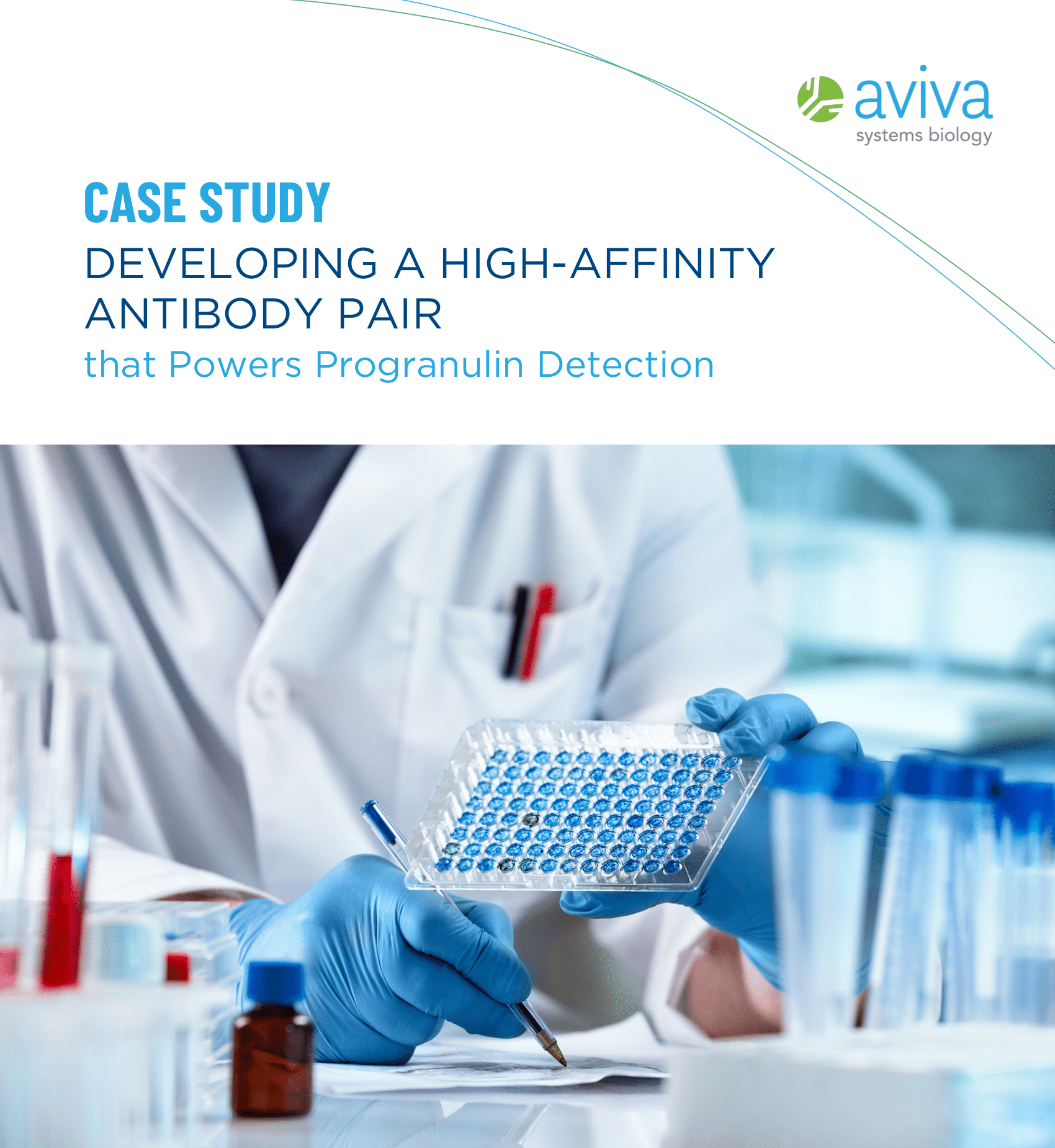
This case study walks through Aviva’s end-to-end recombinant workflow for progranulin - antigen strategy, high-throughput screening, and epitope-guided pairing - and shows how that process translates into a practical immunoassay.
If you need measurement confidence (not just binder availability), this is the fastest way to understand what was tested, what was selected, and why the final pair performs well in real sample matrices.
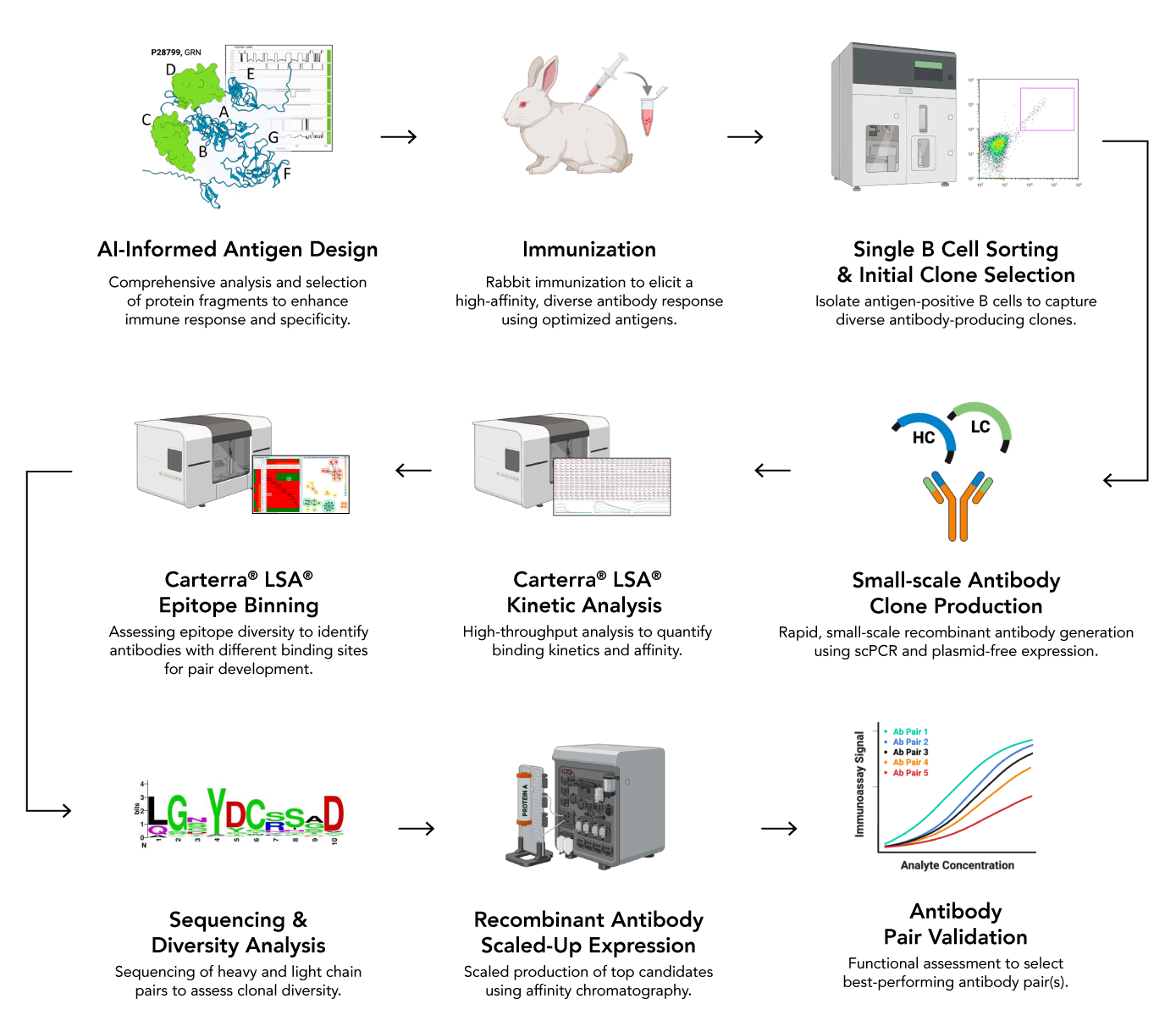
We start with high-throughput recombinant antibody discovery and screening, then down-select using affinity, specificity, and epitope diversity. Top candidates are evaluated as sandwich pairs, optimized in relevant matrices, and carried into an ELISA format that can support real sample measurement.
Related Tool
This Aviva-sponsored talk walks through the start-to-finish approach we use to discover, develop, and characterize antibodies for biomarker measurement - with an emphasis on what actually predicts assay performance.
Key topics covered include:
Highly sensitive immunoassays depend on antibodies that deliver the needed sensitivity, dynamic range, and target specificity across complex samples like CSF and serum (and often plasma). The case study focuses on how Aviva’s workflow rapidly identifies monoclonal antibody pairs that can perform in immunoassay detection of progranulin in clinical samples.
The workflow combines AI-informed antigen design with recombinant discovery, then moves into SPR-based screening for affinity and specificity and epitope binning to identify pairing options. Candidates are then sequenced, scaled up via recombinant production, and advanced into functional sandwich-ELISA testing.
Affinity is characterized using SPR kinetics (reported as KD), and candidates are screened for specificity to both the antigen and full-length target protein. Epitope binning plus dendrogram visualization is used to select antibodies from distinct clades for pairing and sandwich ELISA testing.
Seven capture-detection combinations were tested by sandwich ELISA across multiple progranulin concentrations, and the leading pair was selected based on strongest signals across the range. Additional functional testing in human serum reaffirmed selection before further development.
The top-performing antibody pair was developed into an optimized chemiluminescent ELISA, and the analytical LOD was determined at 14 pg/mL. In this dataset, progranulin was successfully detected in human CSF and serum samples.
Yes. Progranulin levels were measured in CSF and serum from patients with a neurodegenerative condition and age-matched controls using the optimized chemiluminescent ELISA, with successful detection in both matrices and notable differences in average serum signal between groups.